



The Doctrine of Discovery
The Doctrine of Discovery is a 15th-century legal and religious principle that allowed European Christian nations to claim lands inhabited by non-Christians, fundamentally shaping colonialism and Indigenous land rights.
The Doctrine of Discovery originated from 15th-century papal bulls issued by the Catholic Church. In 1452, Pope Nicholas V issued Dum Diversas, authorizing King Alfonso V of Portugal to conquer non-Christian lands, seize their resources, and subjugate their inhabitants. In 1455, Romanus Pontifex extended these rights, granting Portugal authority to colonize and trade in territories inhabited by non-Christians. The most famous papal bull, Inter Caetera (1493), issued by Pope Alexander VI, divided newly discovered lands between Spain and Portugal and mandated the Christianization of Indigenous peoples. These decrees framed non-Christian peoples as occupants rather than legitimate owners of their lands

01
Papal Bull - Dum Diversas- 1452
Dum Diversas (English: While Different) is a Papal bull issued on 18 June 1452 by Pope Nicholas V. It authorized King Afonso V of Portugal to fight, subjugate, and conquer "those rising against the Catholic faith and struggling to extinguish Christian Religion" namely, the 'Saracens' (Muslims) and 'pagans' in a militarily disputed African territory. The document consigned warring enemies that lost to "perpetual servitude. This and the subsequent bull - Romanus Pontifex, issued by Pope Nicholas in 1455, gave the Portuguese a 'moral justification' to freely acquire slaves along the African coast by force or trade. The edicts are thus seen as having facilitated the Portuguese slave trade from West Africa and as having legitimized the European colonization of the African continent.
02
Papal bull - Inter Caetera - 1493
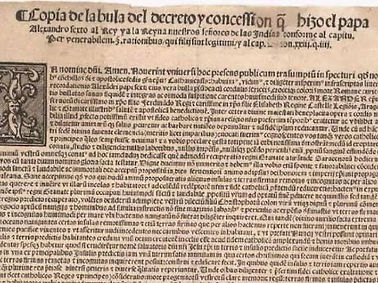
The Papal Bull - Inter Cetara stated that any land not inhabited by Christians was available to be "discovered," claimed, and exploited by Christian rulers and declared that "the Catholic faith and the Christian religion be exalted and be everywhere increased and spread and that barbarous nations be overthrown and brought to the faith itself." This "Doctrine of Discovery" became the basis of all European claims in the Americas as well as the foundation for the United States’ western expansion. In the US Supreme Court in the 1823 case Johnson v. McIntosh, Chief Justice John Marshall’s opinion in the unanimous decision held "that the principle of discovery gave European nations an absolute right to New World lands." In essence, American Indians had only a right of occupancy, which could be abolished.

03
Papal bull Romanus Pontifex - 1455
Pope Nicholas V wrote the bull Romanus Pontifex - 1455 as a follow-up to the Dum Diversas. It extended dominion over ‘discovered’ lands to the Catholic nations of Europe. Along with sanctifying the seizure of non-Christian lands, it encouraged the enslavement of native, non-Christian peoples in Africa and the New World.
04
Project Name
This is your Project description. Provide a brief summary to help visitors understand the context and background of your work. Click on "Edit Text" or double click on the text box to start.

H.R.M. Sultan Kacirebonan with (right) H.R.M. Prince Mohammad Soleh Ridwan of the Legacy Kingdom of Pajajaran, of the coalition of Royal families of Nusantara Indonesia